Friday, August 25, 2023

Congratulations to the Exceptional Nurse 2023 scholarship winners!


Nursing students with a wide range of disabilities are admitted to nursing programs. Disabilities may include hearing loss, low vision, learning disabilities, limb differences, paralysis, mental illness, autism, chronic illnesses and conditions such as multiple sclerosis, lupus and movement disorders.

Financing an education can be a challenge for some students with disabilities. In addition to routine expenses (tuition, room and board, books, uniforms, transportation), students may need to purchase an amplified or electronic stethoscope, computer software programs, or audio books—as well as medications, hearing aids, therapies, prostheses, special equipment or custom alterations to uniforms and lab coats. Working a part-time job may not be possible.

Scholarships are available from ExceptionalNurse.com, a nonprofit resource network for nursing students and nurses with disabilities. The organization provides links to disability-related organizations, technology, equipment, financial aid, employment opportunities, mentors, blogs, continuing education, speakers, legal resources, social media groups, research and related publications.

 The organization has been awarding scholarships to nursing students with disabilities since 2003. The awards are based on academic performance, letters of recommendation, financial need and an essay which answers the questions: “How do you plan to contribute to the nursing profession? How will your disability influence your practice as a nurse”? Due to support from donations and book sales, we were able to award two scholarships.

ExceptionalNurse.com is honored to announce the winners for 2023!!!


Elizabeth Herrera from Tucson, Arizona will be attending the at the University of Arizona. In her essay, she stated, "now I know I am meant to be a nurse to continue to be an advocate for....patients like myself. Furthermore, I always wanted a healthcare provider to look like me: dark black hair, Mexican brown skin and deep brown eyes."

Janelle Eradiri from Freeport, New York is attending the Accelerated BSN program at the State University of New York Downstate. Her essay included,"I am committed to providing patient-centered care, advocating for individuals with disabilities, and fostering a culture of inclusivity with the healthcare system. My disability is not a limitation but a source of strength and motivation, driving me to make a lasting impact in the lives of those I serve." 

Congratulations and best wishes to these deserving future nurses.

Cheers!

Donna

Friday, July 28, 2023

Veteran U.S. Air Force nurse who is legally blind continues to care for others


Julie Harper shared this story about Nadine Jacobson in UCF Today. At age 62, Nadine Jacobson ’23MSN, who is legally blind, has overcome many challenges in life but has persevered in her commitment to lifelong learning.

With a passion for caring for others, she pursued a career in nursing. After earning her bachelor’s degree in nursing, she initially worked at the bedside before joining the U.S. Air Force where she had the rank of captain, worked as a labor and delivery nurse, attended nursing flight school, and served during the Persian Gulf War.

“My plan was to go to medical school to become an obstetrician or midwife and deliver babies,” she says. She even had completed all of her pre-med requirements while being a single parent and serving in active duty.

That journey, however, was cut short after a procedure to remove thyroid cancer triggered a reaction in her eyes — causing her vision to slowly deteriorate.

Despite the challenges of her disability and in life, she continued to care for others as now a mother to five children and she continued to pursue an education, earning a bachelor’s degree in psychology, master’s degree in nursing health policy and a law degree.

After practicing law for several years (she had to close the practice to focus on her family), she returned to school and enrolled in the healthcare simulation program at UCF — one of only a few nationwide.

During the program, she needed to complete clinical rotation and worked alongside renowned simulation expert and nurse practitioner Desiree Díaz in a Central Florida clinic.

“I really enjoyed it, as I really miss being able to be a nurse,” Jacobson says. “I still have a lot of nursing knowledge, and it was great to tap into that and belong in that group again.”

She also spent three days in UCF’s internationally accredited STIM Center.

“They were really excellent at providing accommodations for me,” she says. Those accommodations included hooking up Jacobson’s 27-inch iMac, her “window to the world.”

Read more about Nadine Jacobson at:

Knowledge is Power for Disabled Veteran and UCF Nursing Graduate | University of Central Florida News

Cheers!

Donna

Friday, June 30, 2023

Nurse transforms her life and calls her wheelchair "a gift"


Deborah Sherman wrote this piece about Dr. Terry Chase. 

"One moment, 32-year-old Terry Chase was leaning over the handlebars of her road bike feeling the sun and wind caress her face while her lungs and legs pumped and burned along a 10-mile route in Grand Junction. The next moment, she was airborne."

"She landed on the hot hood of a Lincoln Continental, sprawled across the windshield. It kept going. Chase heard crunching as the car demolished her bike. The driver swerved hard and she rolled off, slamming into the pavement. As he sped away, strangers ran over to help. She couldn’t move. Chase cried, “Where are my legs?” Her back was broken."

In one breath, Chase had gone from an athlete to half paralyzed as her spine shattered leaving her in a wheelchair for life. But today, after living with a disability for 35 years, Chase calls that wheelchair “a gift”.

“The accident knocked the crap out of me or perhaps what was holding me back,” wrote Terry Chase, ND, MA, RN, CEIP-ED, in her book Spoke by Spoke: How a Broken Back and a Broken Bike Led to a Wholehearted Life.

“It turns out the injury that seemed to take away so much actually gave me more and allowed me to live a fuller, expansive life. It’s ironic that after getting hit by that car…and being left half-paralyzed, I finally learned to take the first step toward creating my life.”

Please read more about Dr. Chase at https://news.cuanschutz.edu/nursing/former-cu-nursing-grad-transforms-life-after-near-fatal-cycling-accident-finds-new-reason-to-live-and-serve and view this YouTube video CU College of Nursing: Alumna Terry Chase, ND, MA, RN, CEIP-Ed - YouTube

Cheers!

Donna


Wednesday, June 21, 2023

For nurses with joint hypermobility: A New prototype could be a game changer!

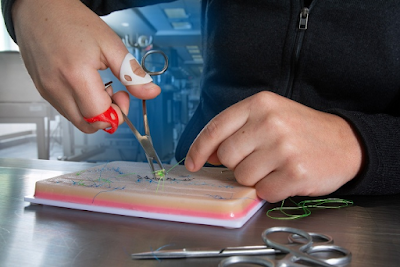
Chloe Cottone uses prototype 3D finger braces to help with her hypermobility issues as she practices using sutures. Photo: Sandra Kicman

Bill Bruton reported this exciting development in UBNow.

"First-year UB medical student Chloe Cottone had a problem that could have quickly derailed her dream of becoming a surgeon. But a collaboration between the Jacobs School of Medicine and Biomedical Sciences and the School of Engineering and Applied Sciences is keeping that dream alive."

"Cottone deals with Ehlers-Danlos syndrome, a group of inherited disorders that affects connective tissues — in this case, her joints. She has hypermobility in her joints, which means she has an unusually large range of movement and is at risk of injury because her joints are too flexible."

“When I was in gross anatomy lab, I struggled to use some of the surgical instruments in conventional ways because of the hypermobility — specifically in my thumbs,” she explains. She tried swan splints, which can be worn on the fingers or thumb and are designed to block hyperextension without limiting flexion.

“There are some companies that make metal ones, but they’re extremely expensive. They were like $100 a pop. And I couldn’t find anything online that did what I needed and could be used under a surgical glove,” Cottone says.

"As a medical student without a lot of extra spending money, she got creative. She went to Michaels, an arts and crafts store, and bought a ring sizer and some copper wire to make something herself. “They worked for a little bit. Unfortunately, they ripped through the surgical gloves,” she says.

"Her gross anatomy instructor, Stuart D. Inglis, instructor in the Department of Pathology and Anatomical Sciences, saw she was struggling. “What she was finding was that when she was holding the scalpel, her fingers would bend in an awkward sort of way and pop out of joint and pop back in, causing her a great deal of pain,” Inglis says.

The prototypes later developed could be a game-changer.


“Surgeons are very dedicated to their job,” McLaughlin-Kelly notes. "They don’t want to give up the operating room, so they operate right up until they can’t. But if they have braces like this that allow them to work longer — the same with people out in the work force in other occupations — this can help prolong their careers,” she says. “It can also be used as a preventive measure. This can make a huge difference in terms of medicine.”

"Cottone says that what started as a small personal project is now something that can have a much larger impact. “Now we are thinking of how we can make these available to other people who work in health care who have hypermobility, who can’t afford several hundred dollars on metal splints.”

Read more about this at:

https://www.buffalo.edu/ubnow/stories/2023/05/collaboration-medical-braces.html?utm_source=FBPAGE&utm_medium=social&utm_term=20230610&utm_content=100004223382932&utm_campaign=General+Content&linkId=100000204985221&fbclid=IwAR1rJD4GfZ5E7GfnHptd9gLVJ1Q8feqmF_vrNProAmYFyGk5tyUy_Z39Pok


Cheers!

Donna

Sunday, May 7, 2023

Seven years after sustaining a spinal cord injury, Gabrielle Baldwin Vanderkuyl graduated with a Bachelor of Science in Nursing

                                                                                Gabrielle Vanderkuyl, BSN

"In 2016, four months before Gabrielle Vanderkuyl was supposed to get her Bachelor of Science in nursing, she ended up paralyzed from the chest down. It’s a moment in her life she doesn’t want to talk about or focus on. Instead, she talked about her hard work and perseverance, which made her graduation dreams come true."

“It’s just moving forward and just knowing that you’re capable of whatever dream that you have and don’t give up,” she said. “Put everything you can do in a bag. Put it on your back. And go forward.”

"Baldwin returned to the School of Nursing in August 2021, seven years after she started the BSN program, ready to wrap up her degree. She needed to audit several courses she had previously taken, finish some classes that had been added since 2016, and complete the last of her clinical rotations."

"She’s come a long way. Now, she has to study for the test to get her nursing license."

Learn more about her journey at:

https://magazine.uncg.edu/newsfront/gabrielle-baldwins-amazing-journey/

https://www.wnct.com/news/north-carolina/uncg-nursing-student-defies-odds-graduates-7-years-after-getting-paralyzed-from-chest-down/?utm_medium=referral&utm_source=facebook.com&utm_campaign=socialflow&fbclid=IwAR3Uiq1K3AjebpMVfgdR1kOzdxMEHseEc6n-0jiJqTacnP0pYF09EVRrvA8


Cheers!

Donna

Wednesday, April 12, 2023

Living with epilepsy and studying nursing: Go out there and be your amazing self!

 David Coates, wrote an article for "Epilepsy Scotland" about Felicity, a nursing student with epilepsy.

How have you managed your epilepsy whilst studying to become a nurse?

"Rest, medication, and hydration!

Remembering to take my medication regularly has been crucial. Also, sometimes I do have to give into side effects such as fatigue.

It’s important to rest when your body tells you to. Staying hydrated also reduces the risk of my medication giving me kidney stones.

It has been important to have a good structure for the working day since Covid has put all of our modules online.

I find that I work best in the mornings, so I do any new material then followed by a decent break and then some revision or light reading in the afternoon.

While on placement in a healthcare setting, I make sure that the nursing staff is aware that I have epilepsy.

This helps us mold my practice learning environment so that I minimise my exposure to triggers but still maximise my learning experience.

I have taken part in GP rehabilitation wards, end of life care, cardiology, and health visiting as well as spending the day with physiotherapists and speech and language therapy.

Nothing has been off-limits so far. It’s just about working together and planning ahead."

What kind of support have you received from your university?

The university has been so supportive. It took a while before I could be persuaded to speak to Disability Services within the university but they have given me so much support and encouragement.

I receive a little extra time to complete any written exams and I am able to sit in a smaller room to minimise the stress of the situation.

This also means that if I feel a seizure coming on, I can make a quick exit to a place of safety.

I have an individual risk assessment for when I am on practice placement which details things such as I shouldn’t be behind a locked door and I may need a water break during my shift.

My first placement was meant to be 12.5 hours shifts which are pretty standard in a hospital environment.

My Advisor of Studies sat down with me and the charge nurse and we agreed that I could work shorter shifts and gradually build-up to the full length so that I could adjust to the levels of work.

The University also applied to the Student Awards Agency for Scotland (SAAS) for a Disabled Students Award.

This Grant gives me access to things such as taxis to placements that are far away or printer ink so that I can print out my lecture notes and not have too much screen time.

I have to also mention my fabulous friends who keep an extra eye on me during long, warm lectures.

We make sure that I sit near the end of an aisle and one of them will come and check on me if I take a long time going to the toilet etc.

I was even a recipient of the Bruce Johnstone Scholarship during my first year. This is an award given to students who have had to overcome adversity to gain a place at university.

Do you feel your epilepsy has stopped you doing what you want to do?

Epilepsy hasn’t stopped me. I won’t allow it to! Sometimes it’s about finding an alternative route to your goal. Yes, there have been times when it has thrown a bit of a spanner in the works.

I missed some time on placement after a particularly nasty seizure, but I worked with the university to find a way for me to stay on course. Having an open and honest dialogue is so important.

I have always wanted to help people. I did put off applying to university because I had the misconception that my epilepsy diagnosis would stop me from working. It turns out that all I needed was a few minor adjustments.

Living with a chronic condition myself has helped me empathise with some of the patients that I have met during my training.

A diagnosis can really knock your confidence at first. It’s good to be able to listen to their worries with a little understanding of what they are feeling.

What would you say to someone who has epilepsy and is worried about going to university?

Get in contact with disability services as soon as possible. They will be able to advise you on every aspect of your student life from how to stay safe on campus, to any special requirements for both learning environments and halls of residence.

Get registered with a local GP, they come to freshers week here. I would advise arranging an appointment to go over how your epilepsy affects you and your individual care plan.

I would also recommend wearing a medical ID of some sort and having your emergency contact stored in your phone under “ICE”.

That way if you do happen to have a seizure on campus people will know that you have epilepsy and who to contact.

Be open and honest with your faculty staff. They cannot help you if you do not tell them that you are struggling whether that is due to your epilepsy or other factors.

Make sure that you pace your studying so that you get plenty of rest and recreation too! Set an alarm for your medication too. It’s so easy to forget when you have such a hectic study/social life.

Most importantly get stuck in and enjoy yourself! Sign up to a society to help you make friends, you are a student for such a short time. Don’t let your condition define you! Go out there and be your amazing self!

Read more about Felicity at:

https://www.epilepsyscotland.org.uk/living-with-epilepsy-and-studying-at-university/

Cheers!

Donna